The Rule of 72 is one of the simplest ways to understand how fast your money can grow.
It is not perfect down to the penny, but that is not the point.
The point is this: the Rule of 72 helps you quickly estimate how long it will take for your money to double.
That is it. No spreadsheet. No finance degree. No complicated calculator. Just simple math that gives you a rough idea of how powerful compound growth can be.
How the Rule of 72 Works
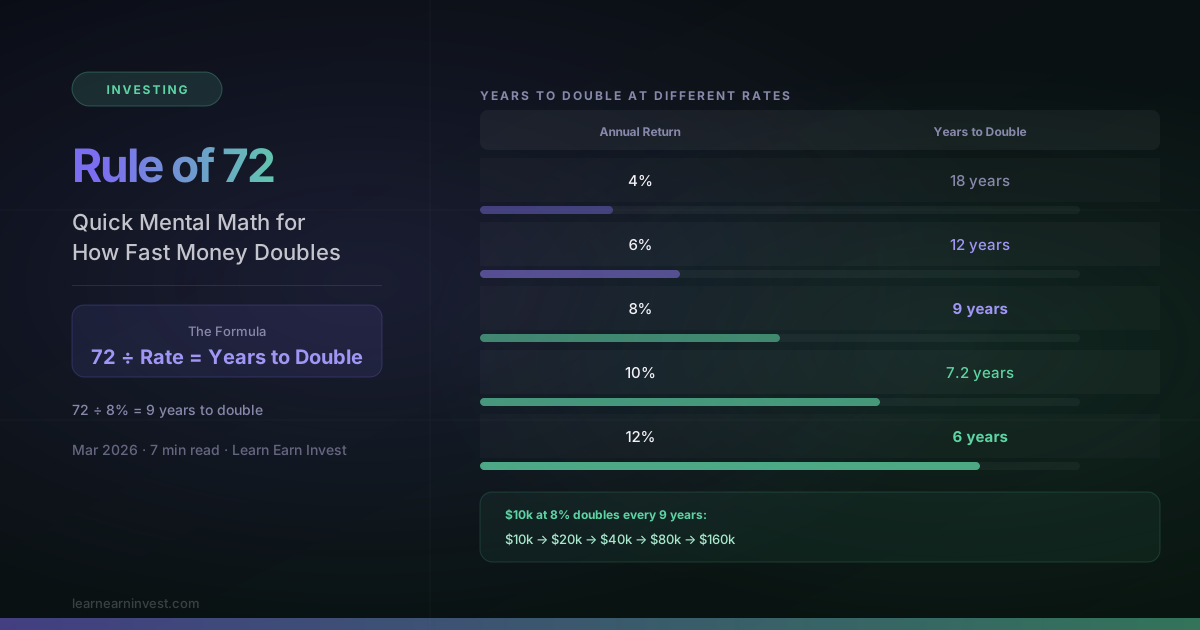
The formula is simple:
So if you earn 8% per year, your money doubles roughly every 9 years.
If you invest $10,000 and earn an average of 8% annually, it could become about $20,000 in 9 years. Then $40,000 in another 9 years. Then $80,000 in another 9 years.
That is why investing gets powerful over time. Not because every single year feels amazing — but because the money starts doubling, then doubling again, then doubling again.
Simple Examples at Different Rates
Here is what the Rule of 72 looks like across common rates of return:
| Annual Return | Approx. Time to Double |
|---|---|
| 4% | 18 years |
| 6% | 12 years |
| 8% | 9 years |
| 10% | 7.2 years |
| 12% | 6 years |
The higher the return, the faster the money doubles. But a higher return is not automatically better if it comes with significantly more risk. Everyone wants 20%, 30%, or 50% returns until they see what the downside looks like. The Rule of 72 helps you understand growth — it does not eliminate risk.
Why This Matters: Doubling Cycles
Most people think about investing in a linear way. They think: "If I invest $10,000 and make 8%, I make $800." That is true for the first year. But that is not the full game.
The real question is: how many times can this money double over my lifetime?
One double is nice. Two doubles is powerful. Three or four doubles can completely change your financial life.
Example: $10,000 Invested at 8%
Using the Rule of 72, money doubles roughly every 9 years at an 8% return. Here is what that looks like with a single $10,000 investment — no extra contributions:
| Years Invested | Approx. Value |
|---|---|
| Today | $10,000 |
| 9 years | $20,000 |
| 18 years | $40,000 |
| 27 years | $80,000 |
| 36 years | $160,000 |
That is without adding another dollar. Just one $10,000 investment left alone.
This is why time matters so much. The longer your money stays invested, the more chances it has to double. And the later you start, the fewer doubles you get. Waiting is expensive.
Early investors are not just ahead by a few years — they are ahead by entire doubling cycles. A $10,000 investment started 18 years earlier could be worth four times as much at the same rate of return.
Why Starting Early Is Such a Big Deal
Say one person starts investing at 25 and another starts at 40. That 15-year difference may not sound dramatic at first. But if money doubles roughly every 9 years at 8%, the person who starts at 25 gets almost two extra doubles compared to the person who waits until 40.
Same starting amount. Same rate of return. Wildly different result — just because of time.
That is the game.
Use the Rule of 72 Calculator to estimate how long it takes your money to double — or find the rate you need to hit a target.
The Rule of 72 Also Works Against You
This is where it gets ugly. The Rule of 72 does not only apply to investments. It also applies to debt.
If you have credit card debt at 24% interest:
That is brutal. This is why high-interest debt is financial quicksand.
When compound interest works for you, it builds wealth. When it works against you, it destroys wealth. Same math. Different side of the table.
Use It as a Reality Check
The Rule of 72 is useful because it gives you a quick gut check on any investment claim.
If someone says an investment earns 6%, you know your money could double about every 12 years. If someone promises 30%, you know that implies doubling in about 2.4 years. That does not mean it is impossible — but it should make you ask better questions.
- What is the risk?
- How consistent is that return?
- What could go wrong?
- Is this real investing, or is this someone selling hype?
Because a lot of people use big return numbers to get you emotional. The Rule of 72 helps you slow down and think.
A Few Important Limitations
The Rule of 72 is an estimate. It works best for reasonable rates of return — especially in the range most investors talk about, like 6%, 8%, 10%, or 12%. It also assumes a steady return, and real life does not work that cleanly.
The stock market does not deliver exactly 8% every year like a paycheck. Some years are up. Some years are down. Some years are flat. So do not treat the Rule of 72 like a guarantee. Treat it like a quick planning tool — a helpful estimate, not a promise.
The Bottom Line
The Rule of 72 is a simple shortcut. Take 72 and divide it by your annual return. That gives you the approximate number of years to double your money.
- At 8%, money doubles about every 9 years.
- At 12%, money doubles about every 6 years.
- At 24% credit card interest, debt can double in about 3 years.
The same force that can build your wealth can also crush you if you are on the wrong side of it. So use the Rule of 72 as a mental filter. Invest early. Stay consistent. Avoid high-interest debt. Give your money time to double again and again. That is how normal people use simple math to build serious wealth.