Compound interest is one of those money concepts that sounds more complicated than it actually is.
At its core, compound interest means your money starts earning money, and then that money also starts earning money.
That is it.
It is not magic. It is not some secret rich-person loophole. It is just math working over time.
But here is the important part: compound interest feels slow at first, then it starts to feel almost unfair. That is why people who understand it early have such a massive advantage.
Simple Interest vs. Compound Interest
Let's start with the basic difference.
Simple interest means you only earn interest on your original money.
For example, let's say you invest $10,000 and earn 10% per year. With simple interest, you would earn $1,000 every single year — because you are only ever earning interest on the original $10,000.
Compound interest is different. With compound interest, you earn interest on the original $10,000 plus the interest you have already earned. So instead of earning 10% on the same number every year, you earn 10% on a growing pile of money.
A Simple Example
Let's say you invest $10,000 and earn 10% per year.
After year one, you earn $1,000. Now you have $11,000.
In year two, you are not earning 10% on $10,000 anymore. You are earning 10% on $11,000. That means you earn $1,100. Now you have $12,100.
In year three, you earn 10% on $12,100, which is $1,210. Now you have $13,310.
The money keeps stacking. At first the difference does not seem huge. But over longer periods of time, it becomes massive.
The Real Power Is Time
Here is where most people get it wrong. They think compound interest is about earning a huge return. It is not. The biggest factor is usually time.
A good return over a short period is nice. A decent return over a long period can change your life.
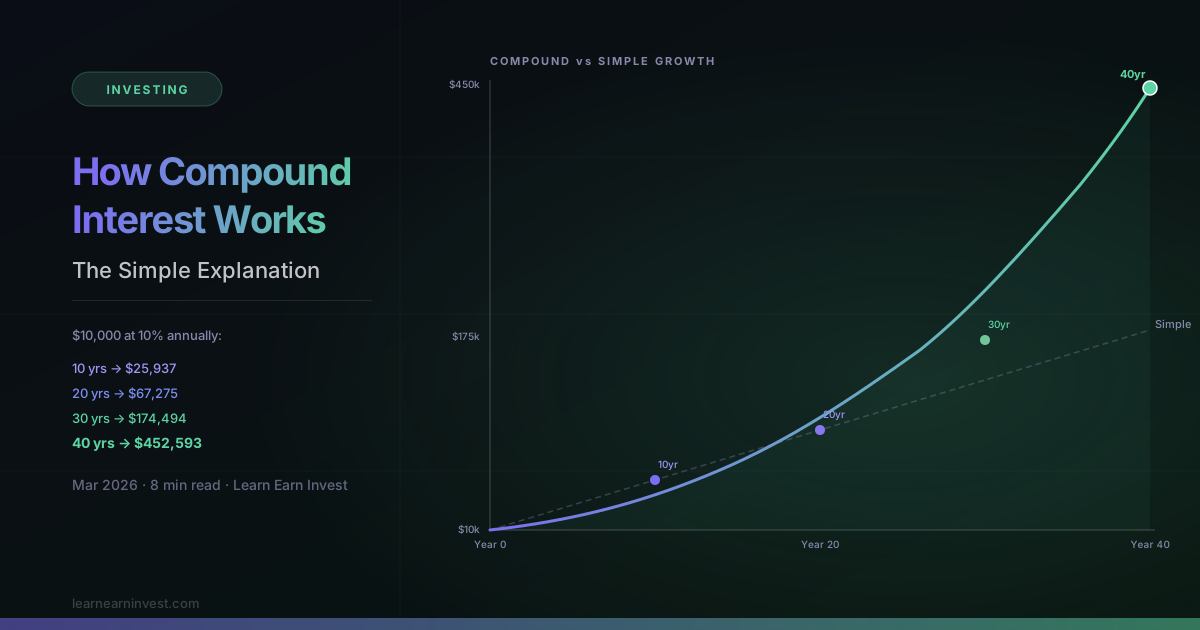
Here is what happens to a single $10,000 investment at 10% per year — no extra contributions, just time:
| Time Invested | Ending Value |
|---|---|
| 10 years | $25,937 |
| 20 years | $67,275 |
| 30 years | $174,494 |
| 40 years | $452,593 |
That is the same $10,000. No extra contributions. Just time.
This is why starting early matters so much. The first 10 years feel boring. The last 10 years are where the math starts getting ridiculous.
The early years are the foundation. The goal in the beginning is not to get rich overnight — it is to build the base that your future returns can compound on.
Why Compound Interest Feels So Slow at First
Compound interest does not feel exciting in the beginning. If you invest $1,000 and earn 10%, you make $100 in a year. That is good, but it does not feel life-changing.
So a lot of people quit. Or they say investing is not worth it. Or they chase some high-risk thing because they want the results now. That is usually where people mess up.
Because eventually, your money starts doing more of the heavy lifting. You just have to give it time to get there.
Contributions Make It Even More Powerful
Most people do not just invest one lump sum and stop. They invest consistently over time. Let's say you invest $500 per month and earn an average annual return of 8%:
| Time Invested | Approximate Ending Value |
|---|---|
| 10 years | $91,000 |
| 20 years | $294,000 |
| 30 years | $745,000 |
| 40 years | $1.74 million |
The key is that you are doing two things at once: adding money consistently, and letting your existing money compound. That combination is powerful. This is where wealth building becomes less about being a genius and more about being consistent.
Use the Compound Interest Calculator to model your starting amount, contributions, rate, and time horizon.
The Formula Behind Compound Interest
The basic formula looks like this:
P = starting principal
r = annual rate of return
t = time in years
But you do not need to obsess over the formula. The main idea is simple: more money invested + higher return + more time = bigger outcome. And of those three, time is the one people underestimate the most.
The Dark Side: Compound Interest Works Against You Too
Compound interest is amazing when you are investing. But it is brutal when you are in debt.
Credit card debt is the obvious example. If you carry a balance at 20% to 30% interest, the bank is compounding against you. You are not building wealth — you are becoming the asset.
The same math that can make you wealthy can also bury you if it is working in the wrong direction. Own assets that compound for you. Avoid debt that compounds against you.
Why Most People Miss Out
Most people understand compound interest intellectually. But they do not benefit from it because they do not stick with it.
- They start investing, then stop.
- They panic when the market drops.
- They wait for the "perfect time."
- They tell themselves they will start when they make more money.
That is the trap. The perfect time to start was years ago. The second-best time is when you actually decide to stop making excuses. You do not need to be rich to start investing. You need to start so you can eventually become wealthy.
The Bottom Line
Compound interest is not complicated. It is just the process of your money earning money, and then those earnings earning more money.
The earlier you start, the more time your money has to grow. The more consistent you are, the more powerful the results become. And the longer you stay in the game, the more the math starts working in your favor.
The boring answer is usually the right answer:
- Invest consistently.
- Avoid high-interest debt.
- Give your money time.
- Do not interrupt the compounding.
That is how wealth gets built.