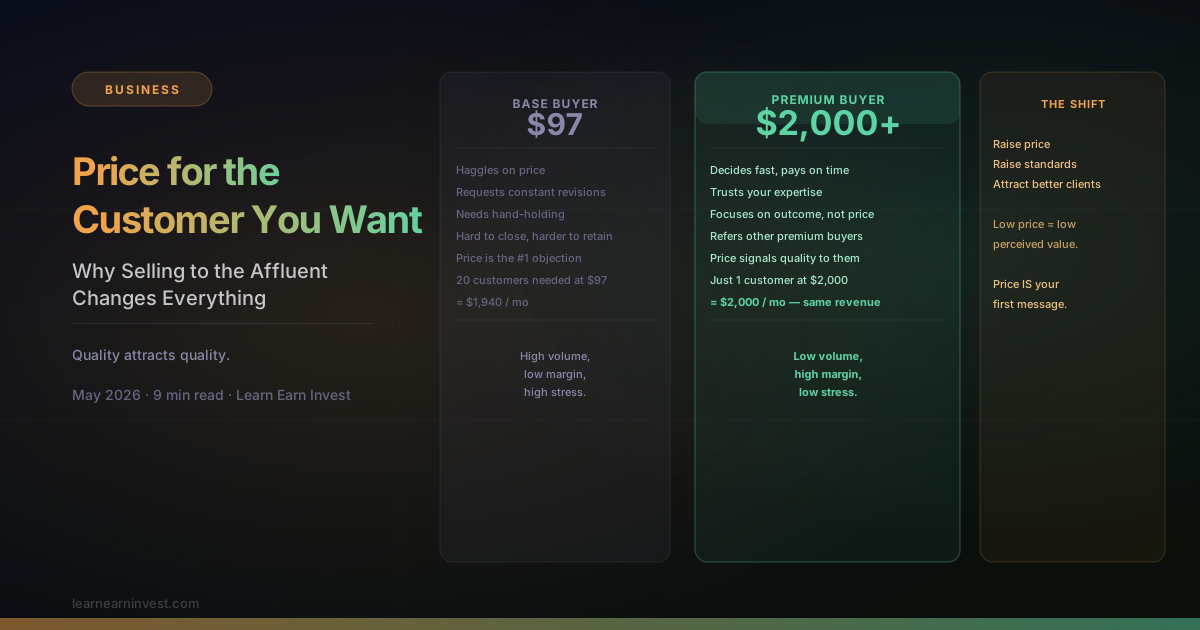
Most businesses stay small because they sell to the wrong customers, set prices based on their own wallet, and build offers that do not allow wealthy buyers to spend more.
Based on Alex Hormozi's video "Why You Aren't Making As Much Money As You Want," here is the full breakdown — with frameworks, pricing math, and an implementation plan you can actually use.
Core idea: Do not fight over low-budget buyers when the profit pool is concentrated in premium customers. Build offers that let high-budget buyers pay you more.
The Wealth Concentration Problem
The bottom 50% of households represents a very large number of people — but a small share of total spending power. The top 10% controls the majority. The top 1% alone controls more than the bottom 90% combined.
This is not a moral statement. It is a market selection problem.
Seeing mostly low-budget people around you does not mean they are your best market. It means you are selling in the wrong place, to the wrong buyer, at the wrong price.
The Pareto Cascade: Where the Real Profit Is
You have probably heard of the 80/20 rule. The stronger insight is that the 80/20 rule applies inside itself.
The top 20% of your customers produce 80% of your revenue. But the top 20% of that top 20% — the top 4% — can produce an outsized share of your profit.
This only works when your business model actually allows a customer to spend more. If your only offer is a $99 package, premium buyers cannot give you more money even if they want to.
The Pricing Math
Here is the simple example from the video that makes it concrete:
| Segment | Customers | Price | Revenue | Lesson |
|---|---|---|---|---|
| Base | 8 | $10/mo | $80/mo | Volume alone is not enough. |
| Premium | 2 | $50/mo | $100/mo | A small buyer count can double revenue. |
| Profit impact | 2 premium buyers | Higher price | Potentially 5x+ profit | Overhead is often already covered. |
When base revenue already covers your overhead, every dollar from premium buyers flows closer to profit. The math disproportionately rewards the premium tier.
Key warning: A $100 offer and a $129 offer are usually the same psychological purchase. A $100 offer and a $1,000 offer force a real segmentation of buyers and value. Tiny upsells are a waste.
What Premium Buyers Actually Pay For
You cannot charge a premium for a commodity. Premium buyers pay to remove three things: risk, delay, and hassle.
| What They Want | What It Looks Like | What to Avoid |
|---|---|---|
| Fast | Priority scheduling, rapid response, shorter timeline. | "We will get to it when we can." |
| Easy | Done-for-you, concierge handling, no coordination burden. | Making the buyer manage your process. |
| Certain | Clearer outcomes, proof, reporting, warranty. | Vague deliverables and weak communication. |
| Status | Best-in-class result, expert delivery, strong presentation. | Looking like every cheap competitor. |
Start High, Then Move Down
Tesla launched with a $100,000 car. Then they built the Model S, then the Model 3, then the Model Y. They used premium brand equity and operational learning to move down market — not the other way.
The reverse is nearly impossible. A discount brand has to fight credibility problems every time it tries to sell something premium. Starting high is a better sequence for most businesses.
For service businesses, premium high-touch delivery is usually a more realistic early path than building low-ticket volume. Fewer customers, better margins, less operational chaos.
The Premium Service Flywheel
When it works, premium pricing becomes self-reinforcing:
- Higher price creates margin.
- Margin allows better people, tools, systems, and delivery.
- Better delivery increases reputation and demand.
- Higher demand supports higher prices.
The flywheel breaks if price rises without real value to back it up. The key is designing the offer before raising the price.
Mental Models for Pricing
- Stop selling from your own wallet. Your affordability is not the buyer's affordability. Pricing based on your own comfort level is a silent business killer.
- Expect more noes. Premium pricing means most people will not buy. That is not failure — that is segmentation working correctly.
- Use an anchor. A high-end option makes the rest of the offer stack feel more reasonable, even if few people buy it.
- Say the price without flinching. Pre-frame with "it is expensive" so both buyer and seller are emotionally prepared.
- Think in value ratios. Budget buyers react to cost. Wealthier buyers ask what the price gets them.
The Close Rate Diagnostic
If your close rate is very high, you may be underpriced. If your close rate is low, the answer is not automatically a lower price. It may be:
- Better qualification — you are pitching premium offers to budget buyers.
- Better offer design — the offer does not justify the price yet.
- Better selling — the value is not being communicated clearly.
The speaker's turning point: He moved from low-ticket fitness packages to high-ticket business consulting. He named a price expecting rejection — the buyer accepted. He raised prices on the next call. He collected more in one day than his old model would have allowed in a month.
The 90-Minute Implementation Sprint
| Time | Task |
|---|---|
| 0–15 min | Write your current offer, price, close rate, and average customer profile. |
| 15–30 min | Define the buyer with 10x the budget. List what they care about. |
| 30–50 min | Create a 5x premium tier and a 10x premium tier. Do not water it down. |
| 50–65 min | Add qualification criteria so you stop pitching premium offers to budget buyers. |
| 65–80 min | Write a one-page sales script presenting the premium offer calmly and confidently. |
| 80–90 min | Pick 10 qualified prospects and schedule outreach. The lesson is useless until tested. |
What to Ignore
- Do not obsess over exact percentages from wealth distribution data. The takeaway is concentration, not statistical precision.
- Do not assume premium pricing fixes a weak offer.
- Do not lower price just because unqualified buyers say no.
- Do not create an upsell that adds operational complexity without a major profit jump.
The Bottom Line
Pricing is not just arithmetic. It is positioning, market selection, qualification, belief, and operations. If you sell a commodity to budget buyers, you are trapped in a low-margin fight. If you design a premium outcome for buyers who can afford it, you can do less volume, serve better customers, and create more profit.
Blunt version: If your offer cannot be sold for 5x to 10x more to anyone, either your market is weak, your buyer selection is weak, or your offer is too ordinary. Fix one of those before blaming the economy or "people being cheap."
Get the complete Pricing & Selling to Premium Buyers summary — frameworks, tables, and the 90-minute sprint — as a PDF you can keep.